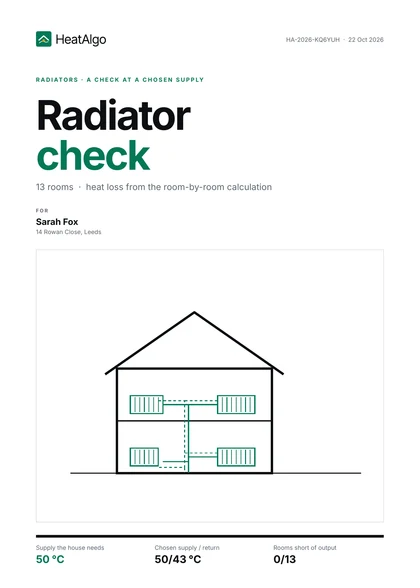
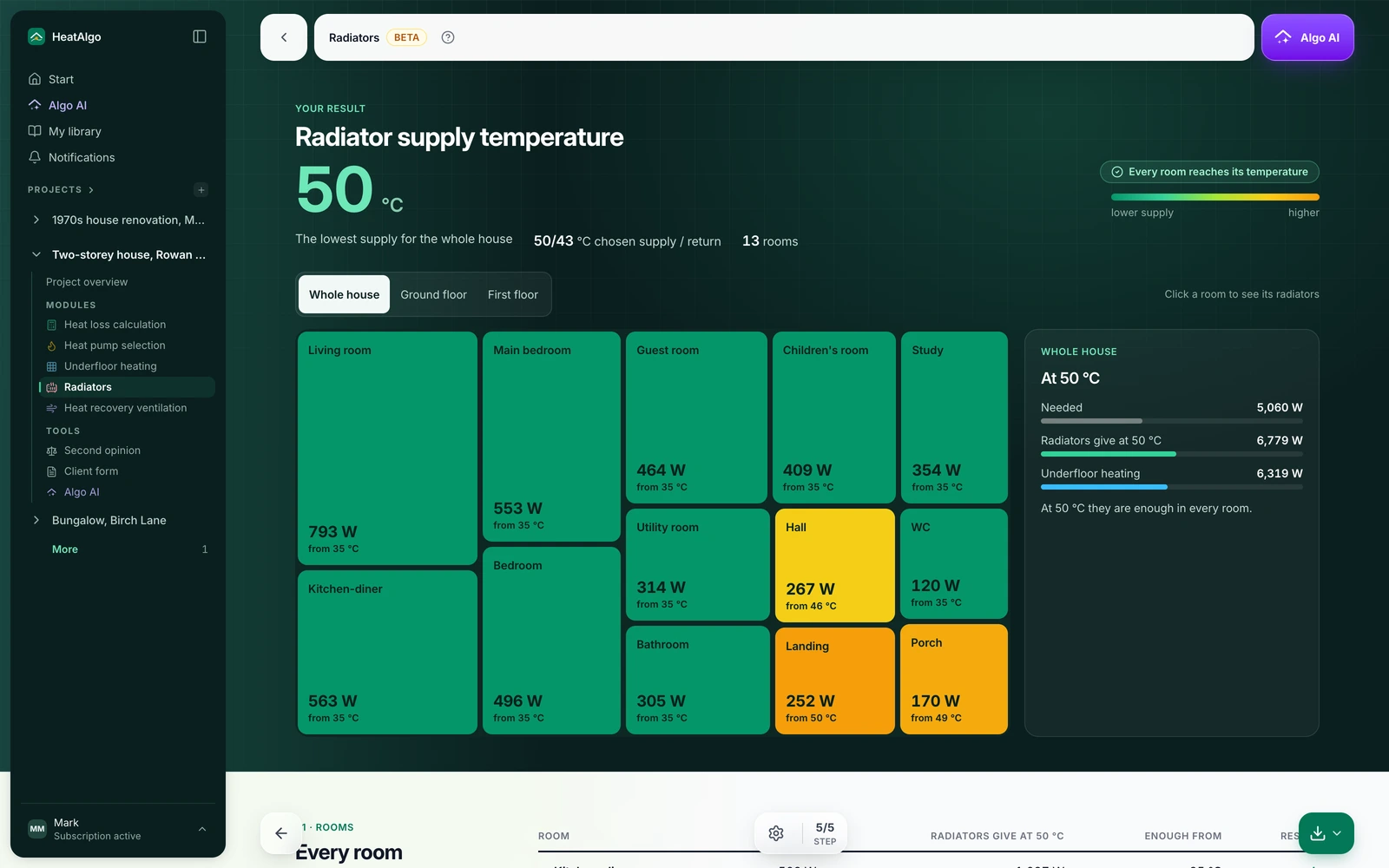
Your radiators heat the house at 50 °Cat 50/43 °C, all 13 rooms have their full output
Which rooms,and what to swap to.
Free: the house's flow temperature and how many rooms are short. After purchase you see every room and the radiator to swap to, and you take the PDF report to your installer.
✓Every room: its load, the radiators' output at your temperature and the balance
✓The flow temperature each room is enough from
✓"What to swap to": the type and size of a radiator that fits the wall
✓A PDF report with the assumptions, the result and the method
A radiator check, not an installation design. You enter the radiators and approve the inputs; HeatAlgo calculates. Go through the result with your installer before you swap anything.
An example house, real files from the app - the same as yours.
What it is
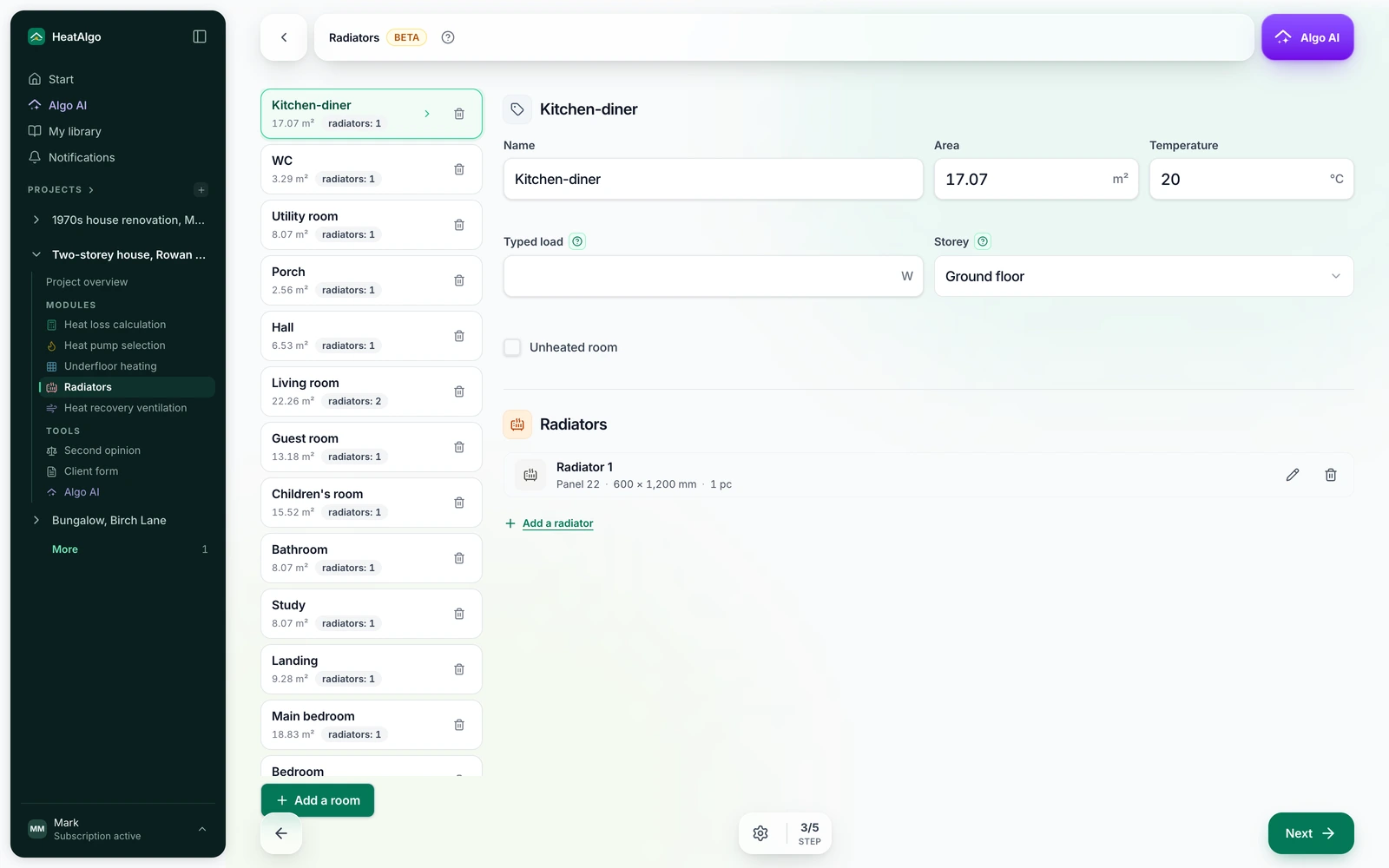
The Radiators module works out each radiator's output at the flow temperature you pick and compares it with the room's load - from the heat loss calculation to EN 12831-1, or from an estimate by floor area. It tells you the flow temperature your radiators can heat the house at, which rooms fall short and which radiator to swap to. A radiator check, not an installation design.
What you getfree and after purchase.
Calculating is free, with a preview of the results. You unlock the full results and the PDF report with a purchase.
Free
The house's flow temperature and how many rooms are short. Change the temperature and see at once how many rooms are then enough.
After buying the module
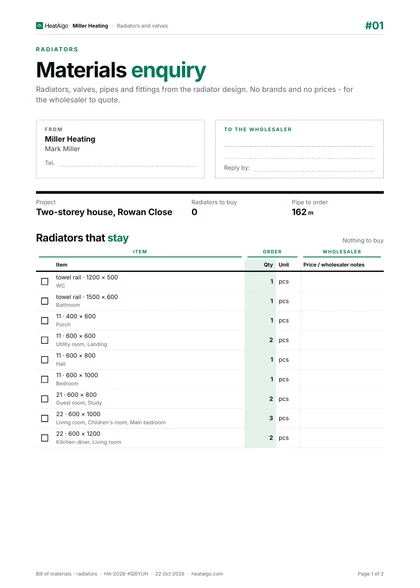
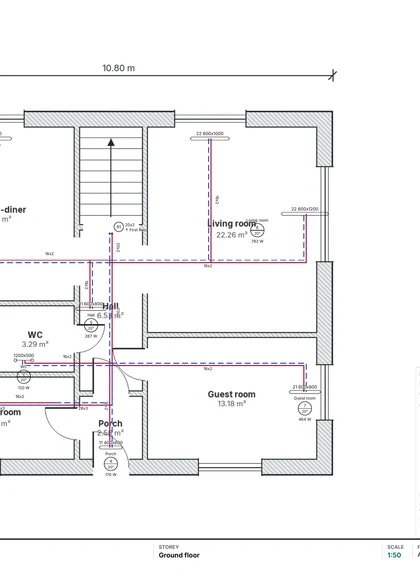
Every room and the radiator to swap to, pipe sizes and valve Kv, pDF report, materials list and drawings.
For installers and designers
A two-pipe network with the pump head and the required Kv of every valve, a materials list with an Excel file, and drawings as PDF and DXF. Calculations and drawings for a heating installation design.
What it does not do
It does not size a heat pump and does not replace an installation design signed by a qualified designer. It does not calculate one-pipe or gravity systems.
A heat pump runs cheapwhen the water is cool.
A radiator sized for a boiler at 70-80 °C gives out clearly less heat at 45 °C. Whether a room stays warm depends on its load and on what hangs under the window.
✕Swapping everything to be safeoften a bigger radiator in two or three rooms is enough
✕A higher temperature for one roomone undersized radiator raises the flow temperature for the whole house
✕Output from the table, not the conditionsthe catalogue gives the output at 75/65/20 °C, and a heat pump runs much cooler
How to checkyour radiators.
1 / 5
A photo of a radiator?Algo AIreads it.
Algo AI reads radiators from a photo, from an old heating design as a PDF, or from what you type: the kind, the type and how many. You type the sizes. Before the reading we remove the EXIF data from the photo, the location included. The algorithm, not the model, works out the output and the result.
Here is a photo of the radiator in the living room - what can you read from it?
THINKING
The kind and the type: a panel radiator, type 22, one of them. I do not read sizes from a photo - type the height and length. I propose the entry for the Living room, and you approve it.The kind and the type: a panel radiator, type 22, one of them. I do not read sizes from a photo - type the height and length. I propose the entry for the Living room, and you approve it.
Ask about a radiator, a room or the temperature…→
What the moduleworks out for you.
A radiator's output at your temperature.
The output from the EN 442 characteristic at the flow and return temperatures you pick, without installation factors and without heat from the pipes. From the radiator's datasheet when you type it; without one, a typical value - the median of several makers' datasheets for that type and height.
Room loads straight from the heat loss calculation.
You take the rooms and their loads to EN 12831-1 from this project's heat loss calculation. Without one the module calculates an estimate by floor area and says so: an estimate, not a calculation to EN 12831-1.
The temperature the house stays warm at.
Change the flow temperature and see how many rooms are then enough. The module gives the lowest temperature for the whole house - and says so when not every room warms up even at the highest.
A replacement radiator that fits.
For a room that falls short the module picks a radiator type and length for the space on the wall you give. When none fits, it says so plainly: raise the temperature or add a radiator.
A pipe network with the pump head and Kv values.
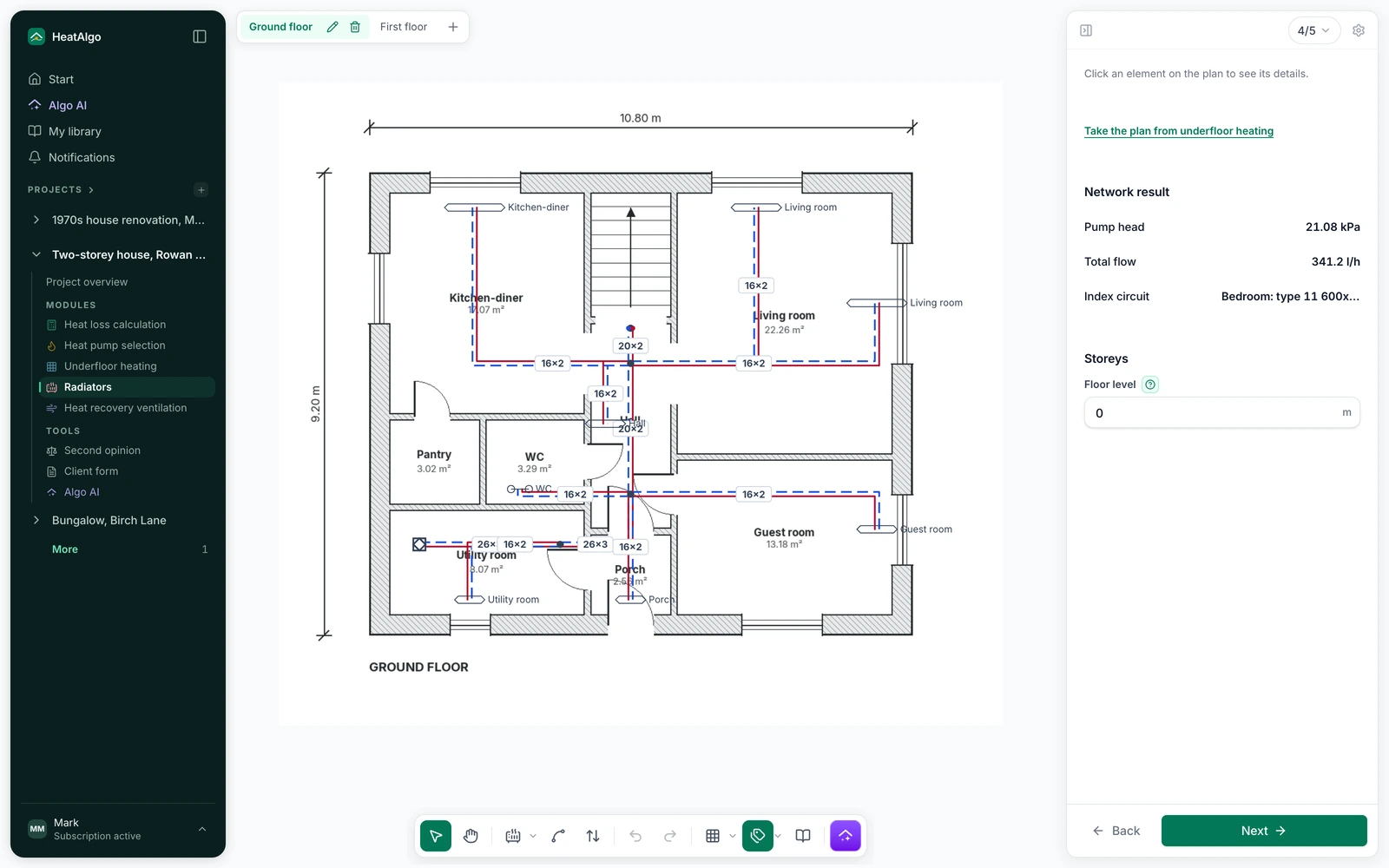
A two-pipe system drawn on the storey plans, with risers: pipe sizes, pressure drops (Darcy-Weisbach, Colebrook-White), the pump head, the index circuit and the required Kv of every valve. You set the valve to its maker's datasheet. Assumed values, such as the maximum velocity, are yours and print beside the result.
Report, materials list with Excel, DXF drawings.
A PDF report, a materials list as PDF and Excel, and drawings as PDF and DXF - calculations and drawings for a heating installation design. A whole-project report for €29 incl. VAT covers all five modules. A report for this module alone from €19.
HeatAlgo vschecking by eye.
A maker's table and a calculator
✕PriceYour time
✕Radiator outputRead from a table at 75/65/20 °C
✕Room loadOne W/m² figure for the whole house
✕Flow temperatureA guess
✕ReplacementSwap them all to be safe
✕Pipe networkA separate program
HeatAlgofree
✓PriceA free account, reports from €19 incl. VAT
✓Radiator outputConverted to your temperature from the EN 442 characteristic
✓Room loadFrom the heat loss calculation to EN 12831-1, or an estimate labelled as one
✓Flow temperatureThe lowest the house stays warm at
a free account · full results and PDF after purchase
Common questions.
No. It is a radiator check, not an installation design. For a designer the module gives calculations and drawings for a heating installation design - the network, the valve settings, the materials list and the drawings - but the design is signed by a qualified designer.
From the radiator's datasheet, when you type the rated output at 75/65/20 and the exponent n. Without one the module uses a typical output: the median of several makers' datasheets for that type and height - check your radiator's datasheet. The output at your temperature comes from the EN 442 characteristic, without installation factors (niche, cover, connection) and without heat from the pipes.
From this project's heat loss calculation - the room loads to EN 12831-1. Without one the module calculates an estimate from the floor area, the insulation and the outdoor temperature. It is an estimate, not a calculation to EN 12831-1 - run the heat loss calculation to check each room on its own load.
Free: the house's flow temperature and how many rooms are short. Which rooms they are, the radiator to swap to, the network with valve settings, the materials list and the drawings unlock when you buy the module or the whole project.
No. It tells you the flow temperature your radiators can heat the house at. Preliminary heat pump sizing is the separate heat pump module of the same project.
A two-pipe system: the heat source, junctions, radiators, an underfloor heating manifold and a low-loss header, over several storeys with risers. One-pipe and gravity systems are not calculated. You set each valve to its maker's datasheet from the required Kv the module gives.
From a photo we read only the kind, the type and the number of radiators. Before any AI model sees it, we remove the EXIF data from the file, the GPS location included. We do not blur faces or documents in the frame, so photograph the radiator alone. The file is deleted 24 hours after the reading starts, and earlier if you stop or discard the reading or the reading fails. The details are in the privacy policy.